Showing posts with label reviews. Show all posts

Monday, September 21, 2020

The Address (Book Review)

The AddressThe Address by Fiona Davis
My rating: 4 of 5 stars

While The Lions of Fifth Avenue has the better title, The Address may have the better plot. While I definitely appreciated all of the facts about the New York City Public Library in the former, I was often distracted by what I felt were inconsistencies in the historical settings; by contrast, The Address doesn't seem to offer up nearly as many factoids, but the timelines are spot on.

One may consider Davis' novels to be a bit formulaic: two women on two different ends of history, one (real) historic building connecting them, with a mystery across decades/centuries to solve. So far, though, the mysteries are not the same, and The Address provided some extra twists that I did not anticipate. And everyone knows it's the above formula that counts, it's the "how" -- how we get there, how the stories connect, etc. Davis seems to have that aspect well in hand.

As with Lions, The Address has an undercurrent of (much appreciated and respected) feminism throughout, much subtler, actually. And she deals with classism as well.
I also like that her main characters are well-rounded. 

**SPOILER**


When we get to the final reveal, our villain isn't a villain with one huge deep dark secret that drops like a bomb; it's a series of "smaller" items that add up to make him not the person we thought he was. I don't think he's 100% bad in way that would seem cliche or stereotypical; that might feel anticlimactic to readers, but I appreciate the nuance.

This novel doesn't exactly have a happy ending; it's far more tragic than The Lions of Fifth Avenue, in my opinion.


I've borrowed Davis' other novels from my local library, and at least one of them does not deal with two women on opposite ends of the century; it will be interesting to see how Davis deals with the shorter timeline(s).

View all my reviews

Wednesday, September 16, 2020

The Lions of Fifth Avenue (Book Review)

The Lions of Fifth AvenueThe Lions of Fifth Avenue by Fiona Davis
My rating: 4 of 5 stars

If you enjoyed A Gentleman in Moscow , you may well enjoy this book as well, with its strong sense of place, both historically and physically with the main building involved. In many ways, The Lions of Fifth Avenue is what I wanted Donna Tartt's The Goldfinch to be: pieces of historical fiction with an art mystery at the center (and no whiny white boy with mommy issues just making the same mistakes over and over again -- can you tell I did not care for The Goldfinch?).

Fiona Davis does extensive research on the buildings in which she places her research, and it shows. I continue to say it's the mark of a good piece of historical fiction when I want to do more research afterward, to see what's "true" and what isn't, to learn about the subject matter. And Davis has done that here; I know more about the New York Public Library than just that it's featured in Ghostbusters, and now I really want to visit it if I ever get back to New York again.

My quibbles are just that --small and probably trivial, but here are they are nonetheless:

**CONTAINS SPOILERS**


  • I nearly wanted it to be longer as I finished it in a day.
  • I sometimes questioned the math regarding the ages and relationships of our two main women, Laura Lyons and Sadie Donovan. I would have expected at least one more generation in between them. If Sadie is 43 during the "present day" (1993) pieces, that means she was born in 1950. So why does she wear vintage 1950s things when those are the very fashions she grew up with? That would be like me wearing 1980s stuff now, which doesn't seem far enough removed to be "vintage" or "retro," just odd.
  • And her brother Lonnie is roughly 10 years older than she is, making him born in 1940 (and a 53-year-old father of a six-year-old girl, still pretty unusual in the 1990s), making their mother (Pearl, age 7 in 1913) 34 when she had Lonnie and 44 when she had Sadie -- that seems a bit of a stretch, especially for a woman in 1940s America.
  • Davis may have been better suited to place Sadie & Lonnie about ten years later in time, inserting another generation between the families. I can see why she chose 1993, though, as she doesn't have to deal with the technology of mobile phones, social media, etc., which can make mystery-writing infinitely more complicated.
  • Even though I said I nearly wanted the book itself longer, the ending/wrap-ups seemed too long. We like to have things wrapped up, and yes, we wanted to know the specific connection of Robin to the family, but that entire section seemed too long. It was a lot of exposition, particularly about Harry, and I don't think we needed that much detail. We wanted to know the connection, but why he stayed away, etc. -- we could have easily filled in the blanks ourselves. So much guilt and cowardice at the end didn't really benefit anyone, audience or characters. I also found the sentencing at the trial to be a bit sanctimonious and heavy-handed.
I'm pleased to discover that Davis has other similar historical books with mysteries at the center of them, and I'm looking forward to reading them.

Tuesday, September 15, 2020

The Other Bennet Sister (Book Review)

The Other Bennet SisterThe Other Bennet Sister by Janice Hadlow
My rating: 1 of 5 stars

**DNF**

I could not finish this book; it was an effort to get through the 100 pages (only 22% of the book!) that I did. It was simply too sad, too depressing.

After I got through the issue of reconciling what I knew of Mary's character from Pride & Prejudice with Hadlow's "version," there was the much larger issue of this "new" Mary's existence being utterly awful. Hadlow seems to have forgotten that Austen's original work is a comedy; this book is not a comedy but some terrible drama about a lonely, misunderstood girl surrounded by one-dimensional characters. While many of the original Pride & Prejudice characters are intended to be ridiculous, farcical, and/or satirical, Hadlow has made them simply mean.

Remembering that this book does "catch up" to the events of P&P, I forced myself to at least read that far, for curiosity's sake. And while I believe this book extends past the events of P&P to continue with Mary's life, I simply couldn't punish myself any further. I have no idea how it ends, but I couldn't endure Mary's misery any longer.

View all my reviews

Monday, September 7, 2020

The Southern Book Club's Guide to Slaying Vampires (Book Review)

The Southern Book Club's Guide to Slaying VampiresThe Southern Book Club's Guide to Slaying Vampires by Grady Hendrix
My rating: 2 of 5 stars

In all fairness to Mr. Hendrix, I should stipulate that my two-star rating has less to do with his writing quality and more to do with the fact that this book was not what I was expecting.
Based on the title and the synopsis, I was expecting something funnier, cleverer, sassier, possibly even sillier. This book is not those things.

I did not expect but did appreciate the feminism, the blasting of 1980s and 90s patriarchy, the acknowledgement of systemic racism and white privilege.

Hendrix lost me at the gore, I suppose. If you are a fan of horror as a genre, you may well enjoy this book and his gruesome turn of phrase. I did not, and a few times considered putting the book down; another point in Hendrix's favor that I did actually finish the novel.

**SPOILER ALERT**

I would also call this "the book of false endings." 

At several different chapters' ends, I expected the next chapter to be a sort of wrap-up, a "where are they now" with our antagonist firmly put in his place with perhaps a smug thought from Patricia and/or her cohorts. That does not happen. The book keeps going, and when the antagonist does finally meet his doom at the hands of the Southern ladies, it is neither clever nor smart nor neatly tied up with a bow; it is, however,...thorough.

View all my reviews

Monday, August 24, 2020

Lady of Devices (Book Review)

Lady of Devices (Magnificent Devices, #1)Lady of Devices by Shelley Adina
My rating: 5 of 5 stars

FINALLY! A steampunk novel that isn't utter crap! I am wary not only of popular things, but of incredibly prolific authors; for some reason, I am suspicious of authors that can "crank out" so many novels, feeling that the writing quality can't possibly be good or sustained (if it starts out well enough). Also too many fancy covers and promises of steampunk with strong women characters have left me utterly disappointed.

Thanks to Shelley Adina, I can finally put my finger on what was missing from those other novels: the Britishness, the Victorian attitudes and mores and language. It's not enough to simply throw some steam gadgetry at your characters and have them drink tea.
Like Gail Carriger, Adina knows how the classes in Victorian England function, in addition to modes of dress, and how the people sound. Far too often wannabe steampunk novels simply don't sound like Victorian England.

My trepidation when starting this book (this series, really) soon vanished. While the overall story arc was absolutely not what I was expecting, I read the entire novel in one sitting and have already purchased the next three. I hope Adina can maintain this trajectory (and my faith in her writing skills).

View all my reviews

The Jane Austen Society (Book Review)

The Jane Austen SocietyThe Jane Austen Society by Natalie Jenner
My rating: 3 of 5 stars

This book is a comfortable read. Not necessarily "comforting," but comfortable, like your favorite jeans or sweater. It's the mark of a good historical piece if it makes me wonder, "Is that true?" or "How close is this to the real thing?", driving me to do some research after reading (or watching). I can save you the trouble, though, as Jenner mentions in her afterword that while the places are real, the characters are not. That's not a bad thing, and I think speaks well for Jenner's writing that I assumed these characters were based, at least a little, on real people.

When discussing Austen, the characters bring up a couple of points of view that I hadn't thought of before or hadn't been taught in academia when studying Austen, so it's always enjoyable to have a different light shown on something. Jenner also (via her characters' discussions) touches on why we re-read Austen (or any piece with which we are intimately familiar); and while I rarely reread books, her sentiment does apply to things I'll rewatch for their comfort. I might pick up and reread some more Austen, too, after reading Jenner's book.

Jenner's allusions to Austen's characters and plots in her own are subtle, not precious or too "on the nose." I like being surprised sometimes, so when I did make a connection, I had that "I should have seen that earlier!" moment, which doesn't happen too often.

Please don't think the entire book is literary analysis because it's not; I just appreciate and gravitate towards those aspects.
This is a comfortable read -- not too taxing, enough Austen for fans, not so light as to be saccharine, but also not something that leaves me needing to know more about these particular characters.

View all my reviews

Thursday, August 20, 2020

The Girls With No Names (Book Review)

The Girls with No NamesThe Girls with No Names by Serena Burdick
My rating: 3 of 5 stars

This was very well-written, although I'm still not entirely sure what to say about it. The tragedies involved are almost Shakespearean with their miscommunication and misinformation. It is a tragedy, but not hopeless, I don't think. Towards the end, I found myself thinking not quite "How are we going to get out of this?" but "How is this going to end in a way that isn't utterly despairing?" But Burdick found a way that was both (mostly) satisfying and still believable within the context of the story.

I read it in under two days, which means it kept my interest the whole time (and that's saying something). The changing point of views in the chapters is well done and not confusing; the same with the changing time periods in the main story timeline. Even as the original "mystery" gets answered, we still want to see how all the different stories come together. The historical aspects feel accurate; also be sure to check out Burdick's afterword as she touches on some important points, including the use of the word "gypsy."

I guess I'm giving it three stars ("I liked it") rather than 4 because I'm unsure what I was supposed to get from it -- other than feminist anger and hatred for organized religion, both of which I already have in spades. It could also be the tragic nature of the stories being told; that's not my usual preference or genre in what I read.

View all my reviews

Tuesday, August 18, 2020

Snowspelled (Book Review)

Snowspelled (The Harwood Spellbook, #1)Snowspelled by Stephanie Burgis
My rating: 3 of 5 stars

This book came recommended from Gail Carriger, whose writing I greatly enjoy, and it was available for free at that particular moment in time.

I enjoyed it for the most part. I particularly like Burgis' feminist take on politics and having a matriarchal society; unfortunately, women are still pigeon-holed, and our brazen protagonist challenges those stereotypes head-on.

My quibbles, I think, mostly have to do with Burgis' writing style. There are several repeated words and phrases (like "cossetted") that could have benefitted from an editor with a thesaurus. "Cossetted" is a good word and definitely appropriate for how it is being used, but it should have been changed up a bit more. Burgis also continually refers to the soft "hiss" sound that the falling snow makes. I grew up in Midwestern winters and have never once heard snow "hiss" -- unless, of course, it was falling on an open flame of some sort. Not only was that bit repetitive, but didn't quite make sense.

Lastly, we continually get reference to whatever traumatic event happened to Cassandra 4 months earlier and she pretty much wanted to commit suicide after. I think that reveal could have come earlier on, as it's a bit anticlimactic where it is; and again, the references to the event (including word choices) grow repetitive to the reader.

I am partially tempted to continue this series as I do enjoy the world Burgis has built, but we shall see.

View all my reviews

The House in the Cerulean Sea (Book Review)

The House in the Cerulean SeaThe House in the Cerulean Sea by T.J. Klune
My rating: 4 of 5 stars

I loved this book. I really did. I may have been slightly hormonal while reading as I cried (often "happy" tears) throughout the entire thing. I also devoured the book in one sitting. The colorful characters, these poor traumatized children; "found family" is one of my favorite tropes.

I also love that Klune does not pull any punches when it comes to bigotry and prejudices; he makes sure you get the symbolism and allegory right away, unambiguously: "Just because you don’t experience prejudice in your everyday doesn’t stop it from existing for the rest of us.”
For all of those moments (many of which I highlighted in my notes), this is a perfect book for right now in 2020.

I gave it 4 instead of 5 stars for the following reasons:
-despite having queer characters and a lot of nontraditional aspects, the two main (adult) characters are still two white men.
-the Black woman character spends most of her time in the kitchen.
-the Black boy character is a "dog."

I realize that the above are not without nuance when reading the actual story, but I think it's important to also realize how the facts look "on paper," so to speak, without context, when attempting to be diverse and inclusive.

Lastly, Phee seemed to be the least developed character. I would not be surprised if an editor said, "You need more than one girl child character. Put in another one," and this is the result. I say that because in almost any of the given situations, you know the reactions of almost all of the children, where they are, and/or what they are doing (often because they are so unique). Except Phee. There is the one scene with her and Linus and Zoe, but other than that, I feel like she is an afterthought.

View all my reviews

Tuesday, February 18, 2020

The Magicians - Almost a Review

The Magicians (The Magicians, #1)The Magicians by Lev Grossman
My rating: 3 of 5 stars

I did not finish this book. I was curious as to how the written texts were different from the show (which I do watch as a guilty pleasure), but simply not curious enough to keep reading. I'm already bored with Quentin's near-constant teenage horniness for nearly every breathing female that crosses her path. I'm also surprised (don't know why) and depressed by the overwhelming whiteness; characters of color in the TV show are boring ol' Anglo-Saxons in the original text.
Frankly, it became too much work to keep reading, especially when I already know (or at least think I know) what major events are going to happen.

I will say one thing in its favor: author Lev Grossman nails on the head what depression often feels like with this one quote:
"Quentin knew he wasn’t happy. Why not? He had painstakingly assembled all the ingredients of happiness. He had performed all the necessary rituals, spoken the words, lit the candles, made the sacrifices. But happiness, like a disobedient spirit, refused to come."

For now, I'll still to indulging in the TV show as it isn't taxing, and I love Margo's swearing.

View all my reviews

Tuesday, July 25, 2017

American Godz on Starz

When it was announced that Neil Gaiman's American Gods was being made into a television show and a good portion of my Twitter went wild, I decided I should read the book (before watching the show, of course, like a good doobie).  When Tom + Lorenzo started posting their reviews and I would catch a glimpse of a costume in their thumbnails, I thought, Now I really need to read this.  And then, eventually, I really need to finish this book.


~Spoilers Follow;  You've Been Warned~

It was a beast of a book to read.  And I'm still not entirely sure why.  Yes, it's 600-some pages long, but I've read longer.  Yes, it deals with a lot of mythology, but hello, Tolkien nerd here.  If I had to try to verbalize (in bullet-point fashion, of course), why getting through this book sometimes seemed onerous, I'd say:
  • Non-linear timelines
  • Non-tangential tangents/storylines
  • A lot of dusty, back road travelling
  • Some tough visualizations (mostly with the coin tricks, but I eventually had to accept that my spatial recognition is sub-part at best and just move on)
Some of those may seem odd (especially the travelling bit), so let me explain.  American Gods the novel is very interior; it is almost entirely Shadow's story with a lot of important pieces taking place entirely in Shadow's memory and/or subconscious.  American Gods the novel is also a literal journey (not just the figurative hero's quest, which it also is); Gaiman does a good job conveying the sense of wandering and sometimes isolation/desolation when traveling the dirt roads of the Midwest and other places.  For someone who doesn't enjoy that sensation (one too many road trips in Midwest growing up), that can be a bit headache-inducing.

There were some points that left me hanging and some things that I just didn't "get."  Many of the "non-tangential tangents" are simply there to show how the old gods came to America.  And that's it.  They are part of a larger tapestry, but on their own, they're sometimes just loose threads.

But I finished it nonetheless and wasn't entirely dissatisfied with the process.  And then my Unit and I started to watch the first season of the television adaptation via Starz.  And damn.

Shit just got real, as they say.

I could write an entire paper on the opening credit sequence alone.  The visualization and symbols used are amazing and intense and I have yet to get tired of watching it.  It's even been nominated for an Emmy (did you know there's a category for opening credits?  I didn't.).

I had read on Twitter from Gaiman himself that:
  • Season 1 ends at House on the Rock
  • Some things happen out of order
I remembered getting to House on the Rock in the book, and I thought Wow, it takes an entire season to get there?

And then shit got even real-ER.  As in there is a veritable shit-ton of stuff happening in this series that simply does not exist in the book.  A friend said, "Oh, so they're expanding the shit out of it?" but I'm still not convinced "expand" is even the right word.  More like "created mythologies to go along with the other mythologies [that Gaiman invented to go with existing mythologies]."  Are you confused yet?  Good.  

First and foremost, Gillian Anderson is a goddess.  Watching her as Media in these different representations is a fucking master class on acting.  She's amazing.  She's never quite doing an "impression" of the famous person/character, but she is unmistakably them and also herself as Media.  And here's where we differ from the books.  Media talks to Shadow as Lucy ("Hey, you wanna see Lucy's tits?") from I Love Lucy, that's there (and awesome).  But then, THEN, THEN Media shows up as:
  • David Bowie (in his blue "Life on Mars" suit)
  • Marilyn Monroe (white dress from Seven Year Itch, complete with wind effects;skirt-blowing)
  • Judy Garland (in her final costume from Easter Parade, complete with a dancing Fred Astaire, of sorts)

It's brilliant and makes me think, Why didn't Gaiman do that?  In fact, I find myself asking that a lot whilst watching.  But more on that later.  Watching Anderson in American Gods is worth the price admission, period.  Any other faults, supposed or real, are washed away.

Another major difference is the treatment of Laura (a.k.a. "dead wife"), as in, she actually gets one.  There's little background to Laura in the book, and I was fine with that.  In fact, I am strongly disliking this extra treatment of her in the series.  I'm not sure if it's the actress or the character, but I am so over her.  Shadow could do so much better than her.  Her initial boredom with life, her treatment of him -- she has few redeeming qualities.  I think I'd rather know nothing about her than know that she really is a horrible human being (dead or alive).  The book offers a small bit of redemption for her, and that was all we needed.  I also appreciated the fact that in the novel she only sporadically showed up to Shadow; we have way too much Laura in this visual version.  It also doesn't help that they cast an actress whose nude body looks like a 12-year-old child, therefore making all of her nude work and sexual interactions really, really uncomfortable.  Eww.

On the positive side, in this incarnation, more Laura means more Mad Sweeney!  Yay!  I am really enjoying Pablo Schreiber's performance; you could have fooled me that he's not actually Irish.  And his IMDb.com headshot makes him look like a psychopath; I think I prefer his Mad Sweeney look.  But I often wondered about Mad Sweeney and the coin (with regards to the book); maybe I just wanted things spelled out for me more.  At any rate, him saying, "She's a lepre-cunt" made me LOL.

More thoughts, Leonard's patented (not really) bullet-point style:

  • Ricky Whittle is a STUNNING man and does very solid work as Shadow Moon
  • Ian McShane does some darn good work as Mr. Wednesday, too.  Not quite the casting coup as Gillian Anderson, in my opinion, but a close runner-up.
  • Hey look, it's Cloris Leachman!
  • "Vulcan."  I see what you did there.  (That entire episode is not in the book, nor are any swords, but I enjoy Corbin Bernsen, so I'll let it slide.  Plus the gun commentary is timely, appropriate, and terrifying.  P.S.  Did you know a Psych movie is coming??)
Unfortunately, I call bullshit on the casting of Kristin Chenoweth as Easter/Aostara.  Yes, she's adorable and should probably always dress in pastels and be surrounded by bunnies.  But in the novel, Shadow specifically uses the word voluptuous to describe Easter.  Despite her many other qualities, wee Chenoweth is decidedly not voluptuous.  It's important because Easter represents life, fertility, the bountiful plenitude of spring and harvests.  She should practically be bursting with womanhood.  They should have cast Christina Hendricks (a.k.a. Joan from Mad Men) as Easter.  Or, y'know, me.  But whatever.

I can see a bit why Hendricks may have scared them off; she plays a lot of strong characters.  They would have missed the adorable "cuteness" of Chenoweth's candy-colored extravaganza.  They would have missed the (cheap?) joke of her getting upset at her own swearing.  I know Hendricks can play sweet and girlie because I've seen Firefly, but I can see that thought process against using her.  Nonetheless, her body type (not to mention her acting chops!) is what Easter requires.

Other changes (really without commentary):

  • Laura interacting with Audrey post-death
  • Ibis and Jacquel sewing Laura back up
  • Mr. Nancy sewing Easter suits for Shadow and Wednesday
  • More of Salim (who is still looking for his Ifrit-lover).
  • Bilquis' back story.
  • Bilquis interacting with Technology Boy
  • Wednesday and Shadow getting caught, arrested, and then an entire police station of workers murdered.
  • Easter joining "the fight."
  • Taking back the Spring.

Continually comparing the show to the book is not necessarily an exercise in futility but not always helpful either.  Sometimes it is just comparison for comparison's sake with no real purpose (English teacher habits die hard).  Having read the book helps point me in the right direction, but (and my English teacher self cringes typing this) I don't think it's all that necessary in order to watch and enjoy the television adaptation.

I've read this far; where the fuck are the pics, Leonard?


I couldn't possibly do them justice, friends.  Do yourself a favor and go read TLo's breakdown and costume analyses of each episode (which is what I'm going to do in a hot second).  They go episode by episode and are therefore much more in-depth than Leonard is here.

Wednesday, July 6, 2016

Book Review: A Hundred Essays I Don't Have Time to Write

100 Essays I Don't Have Time to Write: On Umbrellas and Sword Fights, Parades and Dogs, Fire Alarms, Children, and Theater100 Essays I Don't Have Time to Write: On Umbrellas and Sword Fights, Parades and Dogs, Fire Alarms, Children, and Theater by Sarah Ruhl
My rating: 5 of 5 stars

You MUST read this book. If you are an actor, playwright, dramaturg, technician, director, producer, stage manager, and/or lover of theatre/storytelling of any kind, you need to allow Sarah Ruhl's brilliant essays into your life. There are only a hundred of them (with the longest being maybe three pages); you'd do well to find the time.

Ruhl's wit and wisdom are apparent in the very title, and they carry through her offerings. One of this book's best qualities is that these are a hundred essays she "doesn't have time to write" -- meaning, none of them are too long, and Ruhl isn't necessarily digging for truth or trying to unlock the earth's great mysteries. She asks a lot of questions, but does not force any answers. Ruhl tells some wonderful, touching, funny stories (some of which may or may not have brought me to tears whilst on the treadmill at the gym), but she's not didactic. She'll make you stop and think about storytelling and theatre and drama and communities and our need for play and social interaction. But she'll never make you feel like she's demanding that you think about these things.

I didn't necessarily agree with all of the points she brought up (her bit on subtext in dialogue, in particular, seemed counter to everything I've learned), but I appreciated the opportunity to see another viewpoint and to maybe -- just maybe -- approach some of my own work differently.

I borrowed this book from the library, but that didn't stop me from highlighting a passage in nearly every essay, sometimes two! (On my Kindle, people, don't freak out.) I'm still going to have to buy it so I can go back and read those gems whenever I like.

Like I said, you MUST READ THIS BOOK. This book is a necessary tool of the craft, right up there with Anne Lamott's Bird by Bird: Some Instructions on Writing and Life. The two shall be bosom companions on my bookshelf.

View all my reviews

Thursday, May 19, 2016

Team Iron Man

You should know, before even going into my review of Civil War, which side I'm on.  Tony and I go way back.  It's a matter of loyalty at this point.  And of stubbornness.  So while I'm in the minority, I know which side I'm on.  But enough about me, on to the bullet points!

By the time this post will be published, I will have seen Captain America:  Civil War twice, and naturally, I have thoughts about that.  Here they are in some semblance of an order:
  • They wrote Pepper out of another film.  I realize it's not her movie (it's not even Tony's movie!), but it still feels like a bit of a cop-out.
  • Who else was completely and utterly weirded out by the CGI "young" Robert Downey, Jr.?!?  I was so distracted by his face during that scene I almost missed what was happening.
    • Civil War says this "memory" is 1991, the year the Starks died.  The flashback at the opening of Iron Man 3 (when they're in Switzerland) is in 1999.  I think they may have turned the Way Back Machine back too far for 1991's RDJ.
  • Sokovia?  Really?  His whole deal is "just" about Sokovia?  A friend asked me if rewatching The Winter Soldier would be helpful for this movie, and I said, "As long as you remember who Bucky/Winter Soldier is, you're fine.  In fact, rewatching Age of Ultron would be just as if not more helpful."  And I stand by that.  Because there's a lot more that has to do with Sokovia than anything else (in my opinion).
    • But Zemo's whole modus operandi did feel a little lacking to me.  This theory helped to allay some of that.  (CONTAINS MAJOR SPOILERS)
    • After my second viewing, I've realized that the above theory is incorrect in one major point:  there are bullet holes in the glass of at least four of the five "containers" (fifth container was not shown close on screen to check).
  • Speaking of MacGuffins, what about Crossbones?  Has anyone addressed this yet?  He was only there so the Avengers could cause some (accidental) mass destruction as a final catalyst to the Sokovia Accords.  We never really saw why he was doing it (except Cap "dropped a building" on his face), we did not know what biological weapon he was stealing (or why), and then he was dead before we could even really care.
  • Hello Black Panther!  Leonard loves her some cats, no matter the size.  What I appreciated most about Chadwick Boseman's portrayal is that they managed to make him look both feline and masculine.  We often associate cats with femininity (see:  Freud, literary theories, and DC's Batman), but I felt they managed to make him look, act, and move masculine and cat-like and, of course, bad-ass. 
    "Dude shows up dressed like a cat, and you don't wanna know more?"
  • Speaking of His Catness, what's his deal?  His suit is bullet-proof (possibly made of vibranium), but does he also have super powers?  Or is he just really athletic?  See my list below.
  • The airport fight scene, the one that everyone (Leonard included) lost their shit over in the trailers -- yes, THAT one,...felt a bit stiff and contrived for me at first.  It didn't feel like "THE" fight.  Thankfully Wanda addressed my issue (to Hawkeye):  "You're pulling your punches."  Of course it felt a bit stifled -- no one wanted to actually hurt their friends!  They're holding back, and I could tell.  As soon as that became clear, I felt better.  Even after Wanda's moment, they still (mostly) held back.  And I was glad; they're my friends, too, and I don't want to see any of them get hurt.
  • Spider-Man:  let's address address the Spider in the room.  Everyone (except Leonard) also lost their collective shit over seeing the Spiderling in the trailers.  I said it then and I'll say it now:  he sounds (and looks!) like he's twelve!  It's hard for me to take him seriously (or even like someone who has at least gone through puberty) with his li'l pumpkin face and giant awkward ears.  Yes, his lines were funny, but his intro scene with Tony was, well,...weird.  The timing of their dialogue was off, and not in that "this should be awkward" way; in a "this is awkward because we actors haven't been given proper direction" way.
  • Black Widow's hair was getting dangerously close to the "too fussy" zone in this film; in the mean time, ScarJo is doing her best Farrah Fawcett impression while kicking ass and taking names.
  • Holy Beefcake, Batman!  You know what I'm talking about: 
    Look at my guuuuuuuns!
    This was almost too much, when he switched his grip and we got the bicep pose and the manly grunting face.  There was a fair amount of beefcake in this film compared to the others, and I'm okay with that.  Similarly there was a lot less cheesecake (did you see Black Widow wearing pants, boots, and a COAT in the opening fight scene??), and I'm also okay with that.  Turn about is fair play, fellas.  It's your turn to be objectified for once.
  • Lots of fun lines, too many to quote, really.  Pick your own!
  • I thought the film did a really good job showing the points of both sides of the major argument.  Which is why this is STILL VERY UPSETTING!!! 
    2 against 1 isn't fair, people!
Having seen the movie twice in the theaters, I think I've memorized the lines I like and can now happily wait for it on DVD.  It has also inspired this spreadsheet of superheroes:


Name
Suit?
Training
Power(s)
Evaluation
Black Panther
Yes
Probably some military
Unknown
3 of 5 asses to kick
War Machine
Yes
Military
None
3.5 asses to kick
Iron Man
Yes
Not really
None
Genius playboy billionaire philanthropist
Bucky/Winter Soldier
Yes (well, an arm’s worth)
Military & general brainwashing
None
4 of 5 asses to kick
Black Widow
Nope
Lots of military/assassin
None
ALL the asses to kick!
Captain America
No
Military
Beefy arms.  And legs.  And chest.
Nearly Indestructible
Vision
No
Does having Jarvis in your make-up count?
Synthetic, Infinity Stone, Change Density at any time
Indestructible
Scarlet Witch
No
No
“she’s weird” and can apparently bend reality
Glass Cannon*
Spider-Man
Yes
No
Scaling walls, shooting webbing, enhanced sensory all around
Ask me again after he hits puberty.
Falcon
Yes
Military
None
“Bird costume?  That’s cold.”
Ant Man
Yes
Just Thieving Stuff
None
Not the first I’d call unless I just wanted funny stuff
Hawkeye
No
Military
None
Pretty bad-ass for someone so vulnerable
Thor**
No
Asgardian Military
Giant hammer, lightning & thunder
God-like
Loki**
No
Very little Asgardian Military
Staff with Infinity Stone, glamours
So very pretty
Hulk**
No
No
ANGRY (and giant)
HULK SMASH!

*My friend Casey explained this term:  can hit superhard ("cannon"), y'know, like take down friggin' Vision!  But is also fragile, will down from one punch from Cap ("glass")

**Not pictured in this film


Wednesday, April 13, 2016

Regarding Henry

Hardcore Henry opened this weekend.  I saw the preview for it when I went to see Deadpool not too long ago.  And while I've not seen the movie (and probably won't), I have thoughts to share just based on the preview.

The concept itself is intriguing; the film is billed as a "first-person action film," and I think we often forget in film what "first person" really means.  Even in some novels-turned-films, the first person narrative ends up being one of limited third person in the film treatment (see The Hunger Games trilogy of books/films for a recent example).  So a film really and truly shot from the first person perspective is kind of new or, at the very least, unusual.

Her eyes are UP HERE, Handsy-Man.
The trivia for Hardcore Henry says it was "nearly" shot entirely on GoPro Hero3 Black Edition cameras, so it truly is first-person.  You, the audience, are seeing things from Henry's perspective -- and that's a very limited perspective.  Unless the character is looking into a mirror (which he sometimes does), we (the audience) do not even know what he looks like.  We see his hands, his feet, and the various objects and body parts that go flying by.  Hardcore Henry appears to be the film version of any first-person shooter video game out there  (Halo, Left 4 Dead, Fallout, even Skyrim, etc.).  So, in theory, we know how it should look and feel.  In theory.

But here's why it doesn't (or probably won't) work:  it's too much for we weak humans to handle.  Our eyes (and brains) cannot keep up at that speed.  We cannot register the movement; it all becomes a blur.  There is a reason fight and stunt choreography for film happens at a (slightly) slower pace than real movements:  because we cannot see it1.  In that same vein, film shot and edited from a more third person perspective allow the viewers to see all of the action and at a pace our tiny brains can register.

While all of Henry's action may be happening in real-time or at least from a perspective that looks and feels like real-time, I have my doubts that it will make for a satisfying audience experience (that doesn't end in nausea, or worse).  I find the concept intriguing since, as I said before, we rarely (if ever) get true "first person" in film, but just because something is "new" or "never done before" doesn't necessarily make it "good."  It makes it a gimmick.  And it's definitely "gimmicky" if the piece of art itself has nothing else in its favor (for a film, things like:  an interesting plot, characters who are not flat, well-written dialogue, etc.).

So far, my predictions for the film seem to have come true.  And being the feminist I am, I giggled at this unfavorable review:
"This movie doesn't just whiff on the Bechdel test; it bubbles in a picture of a penis on the Scantron and high-fives itself on the way out."

Now if the Henry producers could make something like this with a decent plot, characters, dialogue and maybe slightly less (nausea-inducing) action, that could really be something.  In the meantime, we'll have to satisfy those urges elsewhere.

I will PUNCH THIS DOOR if I have to!

1I would add that contemporary films are starting to move even "too fast" now.  Compare something like Tim Burton's Batman to Christopher Nolan's Batman Begins.  The action of Burton's film is almost laughable compared to Nolan's (granted, Burton was going for a more comic book feel than Nolan's dark and gritty take, but still).  And I use that as a specific comparison because I've worked the fight choreographer from Batman Begins; I've learned some of those sequences.  And even then, he taught us how to slow down a bit so both the film and human eye can follow; even at that speed, the film itself is sometimes "too fast" (for me at least) to keep up.

Friday, July 4, 2014

Review: The Goldfinch

The GoldfinchThe Goldfinch by Donna Tartt
My rating: 2 of 5 stars

I did not quite care for this book. I finished it through sheer force of will. Part of the reason I think I didn't like it is I didn't know what I was getting myself into. I had the impression it was more of a mystery based on the painting in question, rather than the sort of coming of age story it turned out to be. Don't get me wrong; I enjoy a good bildungsroman, but usually of the female persuasion. It also helps when reading a story of this length to actually like the protagonist. By the time he's an adult, I didn't like Theo.

Well, that's not entirely true. Within the first fifteen pages, I was bored with Theo; I have little patience for boys idolizing their mothers, living or dead. But moving on...

He keeps making poor decisions, and we just have to read along, letting it happen -- again and again and again and again. The entire novel is his downward hate spiral of self-loathing and guilt. It took me so long to finish this book because I would have to stop reading out of either frustration or boredom. Frustration because Theo continues to make the same mistakes again and again (and does not learn from them) and boredom because it's so fucking long.

I know long books. I majored in Victorian literature, for Christ's sake! But every one of Tartt's sections (and each chapter is divided into about five sections) is at least two pages longer than it needs to be. This book needs a good editor to show her where she's reached the peak of each section and to stop; instead Tartt keeps going, hitting us over the head with the non-stop descriptions and rambling sentence fragments.

I found the ending to be anti-climatic. I'm not sure what I was expecting, but this wasn't it. I guess seeing as how (read entire review on Goodreads to view spoiler) Moreover, the last "section" loses Theo's voice entirely and turns into what I can only assume is Tartt where she expounds needlessly on life, death, meaning, fate, yadda yadda yadda. I started skimming because it didn't seem relevant to the story at all, and I don't enjoy other people's moralizing.

I'm giving it two stars instead of one because I did feel compelled to finish it. I would give up, put the book down, then pick it back up again (days or weeks later) just to have stuff get interesting again. Sadly, those interesting bits were usually short-lived, but she did draw me in from time to time.

If you enjoyed this book, good for you, though I don't understand why. I will not be recommending it to anyone except people I feel need to be punished in a literary manner.
View all my reviews

Tuesday, May 20, 2014

Review: Insurgent

Insurgent (Divergent, #2)Insurgent by Veronica Roth
My rating: 3 of 5 stars

Well, here we are again, at the end of a second book in a series, and I've rated it slightly lower than the first book. Again, I say it's because the inner workings of this world (the factions, the Choosing, the Initiations and training) are no longer new. I think it's that kind of minutia that I find fascinating.

As the book began, I actually started to get a little bored. It could be because I had already read the first chapter of Insurgent as a "sneak preview" at the end of Divergent. But more than that, it quickly started to feel like an action movie. Now don't get me wrong; I love action movies. But I want to watch them, not read about them. Just as I started to feel this was going to be nothing more than running and shooting guns, two things happened that both the characters in the book and I had forgotten about: (view on Goodreads to read see the spoiler) The former felt like a much more important plot development than the latter, which sort of feels like "shock value."

It's only about 7/8 through the book where we really find out what we're fighting for, and even then, it's still vague. It was unclear to me (until the very, very end) if Tris knew all of the information from Marcus, et al, but just hadn't shared it with the reader, or if she was flying blind, too. It's only when those things ("THE information") are brought to light that the story becomes truly interesting again because it is no longer recycling old ideas and old conflicts.

Towards the end (during that same 7/8 period), I did find one "continuity" mistake, and that bothered me. It both is and is not a big deal. (spoiler on Goodreads) So someone dropped the ball on that one.

The book ends with a definite cliffhanger, and in a moment of truly good timing from the Universe, my turn on the wait list for Allegiant has come up just as I finished Insurgent. Needless to say, I am intrigued to see how this all ends.
View all my reviews

Monday, May 5, 2014

Review: Cress

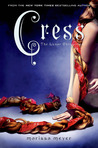
Cress (The Lunar Chronicles, #3)Cress by Marissa Meyer
My rating: 4 of 5 stars

One phrase comes to mind after finishing Cress, the third book in Marissa Meyer's Lunar Chronicles series: "balancing act." While each book is Meyer's take on traditional fairy tales such as Cinderella and Rapunzel, each book also connects those characters in a larger story. By the time we get to Cress, we have Cinderella and her Prince, Little Red Riding Hood and the Wolf, Rapunzel and her Prince, plus their associated collection of stepmothers, witches, and sidekicks. In less skilled hands, that could easily become a tangled mess (pun intended) rather than weaving together multiple storylines for one fast-paced novel.

I did find this one faster paced than Scarlet (hence the higher rating). Unlike Scarlet, it seemed to end on more of a cliffhanger, making me excited to read the next book (Winter), which, sadly, does not come out until 2015.

Like the other novels, Meyer's spin on the Rapunzel tale is clever without trying too hard to be clever. We have
  • a girl with super-long hair
  • who is trapped in a "tower"
  • by a witch
  • rescued by a prince
Meyer is also sure to include two other slightly lesser known aspects of the Rapunzel story; when reading the epigraphs at the beginning of those chapters, I immediately thought, "Oh yeah! That happens!" So bravo to that.

Also, about two-thirds of the way through this book, a couple of other fairy tale items clicked in my head that Meyer has been setting up, but not explicitly stated yet. Specifically, (view spoiler) Well done on that, Meyer! It's not often that I don't see such things coming.

I'm now just sad that I have to wait another year to see how things turn out.
View all my reviews

Sunday, April 13, 2014

Review: Hyperbole and a Half -- THE BOOK

Hyperbole and a Half: Unfortunate Situations, Flawed Coping Mechanisms, Mayhem, and Other Things That HappenedHyperbole and a Half: Unfortunate Situations, Flawed Coping Mechanisms, Mayhem, and Other Things That Happened by Allie Brosh
My rating: 5 of 5 stars

As others have mentioned, this book is a great mix of our favorite Hyperbole and a Half stories (like "God of Cake") and completely new material ("Letter to My Future Self"). If you're already a fan of her writing, you don't need me to talk about the text. What I want to talk about, what I really, really love about this book, though, is its construction. The physical book itself is quite impressive.

[If it's not already obvious, attempting to read this on an e-Reader will not do you any good as a big piece of Brosh's charm are her illustrations.]

The paper is thick and glossy. The book itself has heft; it could be used as a weapon should one need to defend herself while out and about (and reading). The pages for each story or "section" are different colored, all bright and Crayola-looking, leaving no doubt that this book is the Hyperbole and a Half we all know and love. The pages only change color when a new story is introduced, making it very easy to thumb through the book and read each story as one sees fit. We don't need no stinkin' linear reading!

All in all, my feeling is the book was expensive to produce. Prices range from $9 (Amazon Prime paperback) to $20 (hardcover). I think I paid around $14 for my copy. No matter how you slice it, the price (any of them) is a "heckuva deal!" (to quote my step-dad).

Do yourself a favor and buy this in hard copy; laugh and cry with Allie's humor and "unfortunate situations"; enjoy the glossiness of the page; and keep it with you should you need to give someone a concussion.

View all my reviews

Thursday, April 10, 2014

Review: Scarlet

Scarlet (The Lunar Chronicles, #2)Scarlet by Marissa Meyer
My rating: 3 of 5 stars

While I gave book #1, Cinder, four stars, Scarlet only got three. Why? I think I tend to like first books better. In first books, everything is new; the universe is new, the concepts and "gimmicks" are new. I still enjoyed Scarlet very much (I devoured it in one sitting), but the lack of "newness" got rid of that fourth star.

Scarlet, of course, is Marissa Meyer's futuristic rendering of "Little Red Riding Hood." Red's canon involves:
-A girl
-A red hood
-A grandmother
-A wolf
-A huntsman
-A journey

Meyer fulfills all of those in her own way, except maybe (click here to read entire review with spoiler).  However, as it took me a moment to even realize that that was possibly missing, it clearly didn't effect or distract from the story.

Speaking of wolves, I particularly liked (Yes, another spoiler) had "Hello, Little Girl" from Into the Woods running through my head the entire time.

While Cinder ends abruptly, Scarlet does not pick up directly where it left off. We are first introduced to Scarlet and her world, and just when we've forgotten that we were dying to know about Cinder's plight, a chapter will pick up with Cinder's story. The political intrigue continues from Cinder; however, there is less focus on cyborgs as second-class citizens, etc., probably because a cyborg isn't quite the focus of this book. When Scarlet was finished, I definitely still wanted to read book #3 (Cress), but there was not the immediate, burning desire that I had at the end of Cinder.

Meyer, overall, does a nice job of weaving the stories together; these characters all exist in Meyer's same universe, after all, which means that Cress will be quite the balancing act.

View all my reviews