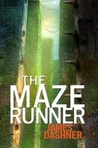
 The Maze Runner
by
James Dashner
My rating:
1 of 5 stars
I did not care for this book. About forty-five pages in, I realized I was unimpressed. I've been on such a dystopian lit. kick lately that I tried to figure out what made this book different and why I didn't like it. So here goes.
Both
The Hunger Games (THG) and
Divergent (D) have female authors;
The Maze Runner (TMR) has a male author. Both THG and D have sixteen-year-old female protagonists; TMR has a sixteen-year-old male protagonist. Both THG and D are written in first person; TMR is written in limited third person. In both THG and D, the "monsters" are other people (mostly the government or ruling parties); in TMR (at least for the first 90% of the book), the "monsters" are actual living breathing (ridiculous, disgusting, impossible) monsters.
In THG and D, while both protagonists go on journeys and discover new information and conspiracies (which we discover along with them), we at least have some context. Information (settings, surroundings, current state of the world at large) is given in bits and pieces of the usual kind of exposition.
The Maze Runner's whole gimmick is that there is no information. The protagonist starts with nothing, no memory, and we, as readers, have jack-squat right along with him. While it's an interesting gimmick, doing it for
over 200 pages is frustrating/annoying/repetitive/a rather stupid concept.
It's the repetition that really started to annoy me. For how long can we listen to adolescent boys argue?
"What have you done?"
"I don't know what you're talking about!"
"What have you done?"
"I don't remember anything!"
Later, rinse, repeat for almost the entirety of this novel. In fact, I bet one could look at the majority of this book -- with its "no idea what to do," "just do what the older boys do" mentality -- as a metaphor for boys' sexual experience (or lack thereof) as teenagers.
Dashner's diction is also repetitive. I counted at least three times where Thomas "may not have had any memories, but was sure he just experienced the worst/saddest/most painful thing." I stopped counting after number three. Dashner also appears to know no other way to describe anxiety or stomach-dropping fear without using the word "acid." If Thomas has as much stomach acid or "acid in his veins" as Dashner says, I'm surprised he did not disintegrate before the end of the novel, consumed from the inside out by the ulcer that was surely eating its way out of his stomach.
Dashner also does not explain several things; I mean, other than the withholding of information. The annoying made-up "slang" the other boys use, for instance: "klunk" is explained, but the rest of the words are not. And the boys use the words
ad nauseum. The resulting "dialect" is grating, annoying, and purposeless. If you're going to swear (or have your characters swear), just do it already. Don't rely on a made-up baby language to do it for you. (In order to view the teensy spoiler here,
read the review directly on Goodreads and click "view spoiler").
Last but certainly not least, the characters are flat and therefore uninteresting. Perhaps that is symptomatic of them having no memories or background. Thomas is a blank slate as is Teresa. The only one remotely interesting is Chuck, the awkward and comedic chubby sidekick, and he's only marginally interesting by the fact that everyone else is
not.
While I forced myself to finish this book, I will not be reading the others in the series. Feel free to tell me if anything interesting happens in those (though I doubt it).

 Matched by Ally Condie


