Showing posts with label literature. Show all posts

Monday, September 21, 2020

The Address (Book Review)

The AddressThe Address by Fiona Davis
My rating: 4 of 5 stars

While The Lions of Fifth Avenue has the better title, The Address may have the better plot. While I definitely appreciated all of the facts about the New York City Public Library in the former, I was often distracted by what I felt were inconsistencies in the historical settings; by contrast, The Address doesn't seem to offer up nearly as many factoids, but the timelines are spot on.

One may consider Davis' novels to be a bit formulaic: two women on two different ends of history, one (real) historic building connecting them, with a mystery across decades/centuries to solve. So far, though, the mysteries are not the same, and The Address provided some extra twists that I did not anticipate. And everyone knows it's the above formula that counts, it's the "how" -- how we get there, how the stories connect, etc. Davis seems to have that aspect well in hand.

As with Lions, The Address has an undercurrent of (much appreciated and respected) feminism throughout, much subtler, actually. And she deals with classism as well.
I also like that her main characters are well-rounded. 

**SPOILER**


When we get to the final reveal, our villain isn't a villain with one huge deep dark secret that drops like a bomb; it's a series of "smaller" items that add up to make him not the person we thought he was. I don't think he's 100% bad in way that would seem cliche or stereotypical; that might feel anticlimactic to readers, but I appreciate the nuance.

This novel doesn't exactly have a happy ending; it's far more tragic than The Lions of Fifth Avenue, in my opinion.


I've borrowed Davis' other novels from my local library, and at least one of them does not deal with two women on opposite ends of the century; it will be interesting to see how Davis deals with the shorter timeline(s).

View all my reviews

Wednesday, September 16, 2020

The Lions of Fifth Avenue (Book Review)

The Lions of Fifth AvenueThe Lions of Fifth Avenue by Fiona Davis
My rating: 4 of 5 stars

If you enjoyed A Gentleman in Moscow , you may well enjoy this book as well, with its strong sense of place, both historically and physically with the main building involved. In many ways, The Lions of Fifth Avenue is what I wanted Donna Tartt's The Goldfinch to be: pieces of historical fiction with an art mystery at the center (and no whiny white boy with mommy issues just making the same mistakes over and over again -- can you tell I did not care for The Goldfinch?).

Fiona Davis does extensive research on the buildings in which she places her research, and it shows. I continue to say it's the mark of a good piece of historical fiction when I want to do more research afterward, to see what's "true" and what isn't, to learn about the subject matter. And Davis has done that here; I know more about the New York Public Library than just that it's featured in Ghostbusters, and now I really want to visit it if I ever get back to New York again.

My quibbles are just that --small and probably trivial, but here are they are nonetheless:

**CONTAINS SPOILERS**


  • I nearly wanted it to be longer as I finished it in a day.
  • I sometimes questioned the math regarding the ages and relationships of our two main women, Laura Lyons and Sadie Donovan. I would have expected at least one more generation in between them. If Sadie is 43 during the "present day" (1993) pieces, that means she was born in 1950. So why does she wear vintage 1950s things when those are the very fashions she grew up with? That would be like me wearing 1980s stuff now, which doesn't seem far enough removed to be "vintage" or "retro," just odd.
  • And her brother Lonnie is roughly 10 years older than she is, making him born in 1940 (and a 53-year-old father of a six-year-old girl, still pretty unusual in the 1990s), making their mother (Pearl, age 7 in 1913) 34 when she had Lonnie and 44 when she had Sadie -- that seems a bit of a stretch, especially for a woman in 1940s America.
  • Davis may have been better suited to place Sadie & Lonnie about ten years later in time, inserting another generation between the families. I can see why she chose 1993, though, as she doesn't have to deal with the technology of mobile phones, social media, etc., which can make mystery-writing infinitely more complicated.
  • Even though I said I nearly wanted the book itself longer, the ending/wrap-ups seemed too long. We like to have things wrapped up, and yes, we wanted to know the specific connection of Robin to the family, but that entire section seemed too long. It was a lot of exposition, particularly about Harry, and I don't think we needed that much detail. We wanted to know the connection, but why he stayed away, etc. -- we could have easily filled in the blanks ourselves. So much guilt and cowardice at the end didn't really benefit anyone, audience or characters. I also found the sentencing at the trial to be a bit sanctimonious and heavy-handed.
I'm pleased to discover that Davis has other similar historical books with mysteries at the center of them, and I'm looking forward to reading them.

Tuesday, September 15, 2020

The Other Bennet Sister (Book Review)

The Other Bennet SisterThe Other Bennet Sister by Janice Hadlow
My rating: 1 of 5 stars

**DNF**

I could not finish this book; it was an effort to get through the 100 pages (only 22% of the book!) that I did. It was simply too sad, too depressing.

After I got through the issue of reconciling what I knew of Mary's character from Pride & Prejudice with Hadlow's "version," there was the much larger issue of this "new" Mary's existence being utterly awful. Hadlow seems to have forgotten that Austen's original work is a comedy; this book is not a comedy but some terrible drama about a lonely, misunderstood girl surrounded by one-dimensional characters. While many of the original Pride & Prejudice characters are intended to be ridiculous, farcical, and/or satirical, Hadlow has made them simply mean.

Remembering that this book does "catch up" to the events of P&P, I forced myself to at least read that far, for curiosity's sake. And while I believe this book extends past the events of P&P to continue with Mary's life, I simply couldn't punish myself any further. I have no idea how it ends, but I couldn't endure Mary's misery any longer.

View all my reviews

Tuesday, August 18, 2020

The House in the Cerulean Sea (Book Review)

The House in the Cerulean SeaThe House in the Cerulean Sea by T.J. Klune
My rating: 4 of 5 stars

I loved this book. I really did. I may have been slightly hormonal while reading as I cried (often "happy" tears) throughout the entire thing. I also devoured the book in one sitting. The colorful characters, these poor traumatized children; "found family" is one of my favorite tropes.

I also love that Klune does not pull any punches when it comes to bigotry and prejudices; he makes sure you get the symbolism and allegory right away, unambiguously: "Just because you don’t experience prejudice in your everyday doesn’t stop it from existing for the rest of us.”
For all of those moments (many of which I highlighted in my notes), this is a perfect book for right now in 2020.

I gave it 4 instead of 5 stars for the following reasons:
-despite having queer characters and a lot of nontraditional aspects, the two main (adult) characters are still two white men.
-the Black woman character spends most of her time in the kitchen.
-the Black boy character is a "dog."

I realize that the above are not without nuance when reading the actual story, but I think it's important to also realize how the facts look "on paper," so to speak, without context, when attempting to be diverse and inclusive.

Lastly, Phee seemed to be the least developed character. I would not be surprised if an editor said, "You need more than one girl child character. Put in another one," and this is the result. I say that because in almost any of the given situations, you know the reactions of almost all of the children, where they are, and/or what they are doing (often because they are so unique). Except Phee. There is the one scene with her and Linus and Zoe, but other than that, I feel like she is an afterthought.

View all my reviews

Tuesday, August 7, 2018

Things Great and Small

My train of thought is a weaving, waving bit of transportation, but sometimes I end up at the depot of "How Would I Teach This (If I Were Still Teaching)?"  Last night's excursion went something like this.  Bear with me down this rabbit hole...

I am currently reading Starless by Jacqueline Carey (highly recommend!) and was thinking of how much I'm enjoying it.  And then I immediately compared it to another book I'm reading:  Homer's IliadThe Iliad is keeping my attention a lot less than Carey's novel, and so I got to thinking about why.  I never had to teach (or read) The Iliad, but I did teach classic Greek plays and Beowulf, and my goal was always to get my students to make connections between these ancient "classics" and contemporary literature, TV, film, pop culture, etc. because many of the elements of storytelling, of tragedy, of comedy, remain the same.  So how could I teach something like The Iliad if even I wasn't liking it?

So of course I went to asking students what they like about things they read and watch right now (particularly in the sci-fi/fantasy genre).  When I've taught, this is the section where they just get to shout things out loud and I get to write on the board (writing on the board was a huge reason why I started teaching in the first place).

  • Epic
    • maybe meaning large scale, like creating entire worlds
    • maybe meaning giant, impressive battles
  • Attention to detail
    • So much food!
    • Fashion!
    • [more on attention to detail/world-building later in a wholly different blog post]
  • Great deeds
    • swords and dragons and rescuing people from monsters
    • saving people from famine, being a voice for the downtrodden
And then I thought about The Lord of the Rings (frankly, when don't I think of LotR?).  While I will always contend that Jackson's adaptations of the trilogy are fairly faithful, incredibly well done interpretations of Tolkien's text (FIGHT ME!), there is one large, huge almost (pun intended; wait for it) difference:  Jackson's films have some beautiful, "epic" even, battle sequences.  I'll never forget the intense anxiety and fear I felt watching the battle in the mines of Moria for the first time on the big screen ("They've got a cave troll!").  There were so few of the Fellowship and so, so many of them, the orcs and goblins.  [Sidenote:  what is it about attempting to barricade a door against an oncoming horde that gives me palpitations?]  And at least four of "ours" were so very, very small.  Literally.  Small and woefully unprepared for battle of any kind.

And therein lies the difference.

Tolkien purposely did not write an epic heroic adventure filled with the usual heroes -- strapping swordsmen cutting a swath through the fray.  No, his heroes were two very small, very usual hobbits.  And while the battles do happen in the books, they often feel removed from the main action, almost in the background.  Because the main action is that of our two small heroes doing an awful lot of walking.  Seriously.  So, so much walking.  And then more walking.
(And occasionally breaking into song.)
Then we walk some more!

Because Tolkien's point (in addition to attempting to create a mythology specifically for Britain) was that small, "normal" folk can do epic things.  People who aren't martially trained, people with no talent for statecraft can accomplish things simply through virtue of being themselves with their own points of view.  They'll not come out of it the same as they went in, of course, because this is still a hero's journey (and that is the foremost marker of a hero's journey:  change), but they're a different kind of hero altogether.

And I think that, both in Tolkien and in other pieces of literature, touches on the very heart of human existence:  we want to do great things -- not just good things, but great things.  We want to complete a great quest, we want to bring salvation to a group of people, we want to be a hero of some kind.  But we are also so very small and normal, walking around in these very fragile bags of skin and water.  So the bringing together of the great and small like that is something we all hope to achieve, being able to accomplish these things just by being ourselves (and, apparently, doing a lot of walking; even hobbits have to do cardio).

And while I was sitting outside on the steps of my patio last night, with a drink and a cigarette, having these thoughts about things great and small, Dogzilla turned and rushed in the darkness to attack something.  It was an owl.  I know it was an owl because, thanks to a street lamp, I could see her/him/they outstretch their wings and silently, gracefully lift up and away from Dogzilla's reach, effortlessly, like pulling silk backwards.
Sorry, Dogzilla, but you are neither hobbit nor orc in this scenario; you are meddling mankind, and the owl is Gandalf.  And the wisdom of wizards (and owls) is always just out of reach.

Prosaic Little Epilogue:  As soon as the owl was out of sight, I scooped up my tiny circus dog and put him inside.  And Dogzilla soon followed.  And then I refilled my glass of Prosecco and went back outside to see if the owl would return.

In a few moments, there was a flicker of movement out of the corner of my left eye; the owl had landed upon the power line running between my house and the next.  That same street light reflected just the tiniest bit off of the owl's lighter-colored breast feathers.  That and those first occasional flutters of movement were the only way I could tell the owl was there.
[When you've worked around animals for years, you learn to not look directly at them, but to look towards the center and use what we Viewpoints actors call "soft focus" -- let your gaze relax; the periphery opens just a bit further, and then pay attention to the movement that happens.  Ask me about the ways to see "hard to find" zoo animals!]
So I continued to sit there, drinking and smoking, attempting to make my movements smooth and slow so as to not disturb her/him/them.  It wouldn't have mattered.  S/he was far enough away that I wasn't a threat and I'm fairly certain they gave zero fucks about me.  Sometimes I even reached for my wine glass to my right without looking, not wanting to lose sight of them in the darkness (and my very poor eyesight, particularly in the dark) as nearly any and all movement had stopped.  At one point I raised my glass to them.  Salut.

I stayed out in the sweltering heat as long as I could (over 90 degrees after 9 p.m.!), through two cigarettes and down to the dregs of my wine and finally went inside.  The owl didn't move.  After I was inside, I looked out the giant dining room window at the power line, but due to the angle, I couldn't see if s/he was still there.  And then I went to bed, dare I say somewhat peacefully.
Salut.


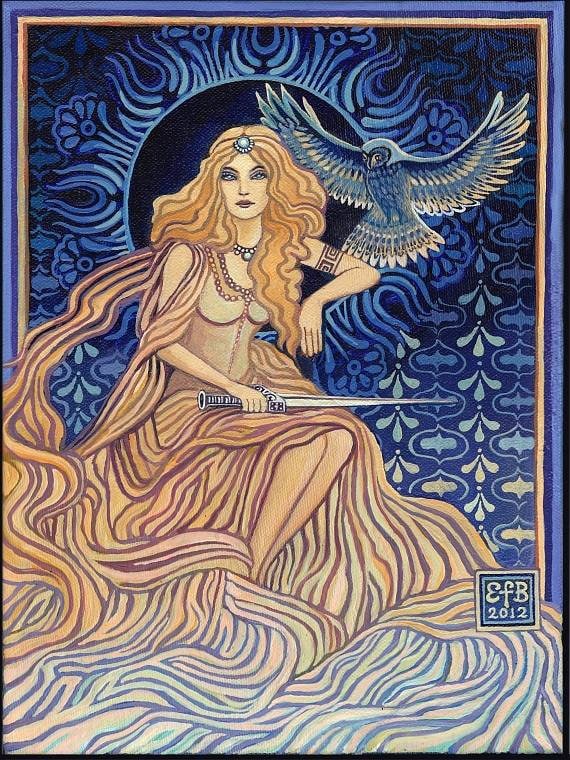
Goddess Artwork by Emily Balivet

Saturday, February 6, 2016

Downton Rant-y

Now that most of the U.S. masses have caught up, I can post this small rant regarding this most recent (and final) season of Downton Abbey.  What has stood out to me most so far are the incorrect literary references made by the upper-class characters!  What the hell, Julian Fellowes?  Let's take a look-see.  (WARNING:  Spoilers for episodes 6.1-6.5)

Episode 6.1:
The family is all atwitter about another great estate being forced to sell their home and family heirlooms.  When getting ready to go view said auction, Mary comments, "The Fall of the House of Usher."

Oh, Mary dear.  Perhaps do more research next time, rather than trying to sound smart.  In Edgar Allan Poe's The Fall of the House of Usher, the "great house" is ruined not because of (lack of) money, but because of incest. illnesses (mental and physical, possibly results of said incest), and lack of an heir.  Unless you know something about the Darnleys that we don't, I'd say this one is way off the mark.

Episode 6.4:  This one's a two-fer.

I'm sure we've all commented and ranted about the family's inability to call the new Mrs. Carson "Mrs. Carson."  But Lady Rosamund takes it a step too far.  During the welcome back party for the newlyweds, Lady Rosamund says it's like "Jane Eyre insisting she be called Mrs. Rochester."

No, Lady R, it's nothing like that.  While Jane is well within her rights to be called by her married name, she did, indeed, marry far outside of her sphere -- a governess to a landed gentleman.  (Although technically, governesses were neither servants nor family, but existed in a strange limbo in between, but that's for another time.)  Carson and the former Mrs. Hughes are both servants. Moreover, they are "equal servants," if that makes any sense.  They are both at the top of their respective household lines as housekeeper and butler, as opposed to a scullery maid marrying the head butler, or a kitchen boy marrying a lady's maid, or, I don't know, the chauffeur marrying the daughter of the house.  I love Rosamund (that woman can work a chair!), but she would have been better off keeping this remark to herself.

Posture, bitches!
Screen grab courtesy of Tom and Lorenzo

In the same scene, Lady Mary actually says something kind to her sister, Lady Edith; she encourages the hiring of a woman as editor as "it is a woman's magazine."  When Lady Rosamund remarks on her unusual niceness, Mary says, "A monkey could type out the Bible if you leave it long enough."

You were so close on this one, Mary!  Emile Borel's theory, commonly called "the infinite monkey theorem," states that an infinite number of monkeys typing on an infinite number of typewriters would eventually type out a specific text (usually Shakespeare's Hamlet).  Some people say they will type out the Bible, so I may be able to let this one pass -- if the other two weren't so egregious.

Now one could posit that Fellowes made these incorrect allusions purposefully, in order to make the upper classes look foolish.  I call shenanigans on that theory!  Since when has Fellowes ever allowed his upstairs characters to be or look stupid without someone calling them on their stupidity?  Nope, I think this is just bad writing.  Perhaps less time should have been spent on making sure Lord Grantham's demise was grotesque and medically accurate, and a little more spent on researching actual dialogue.